Canadians are currently paying some of the highest cable television bills in the entire world. Monthly statements regularly exceed $100 for basic packages, leading many households to question the value of traditional broadcasting. As living costs continue to climb, entertainment expenses are often the first to face scrutiny when families sit down to review their budgets.
Because of these steep prices, the cord-cutting movement is accelerating across the country. Viewers are actively seeking alternative ways to consume their favorite sports, news, and movies without breaking the bank. This growing frustration has pushed one specific alternative into the spotlight, causing thousands to ask if it is finally time to make a change.
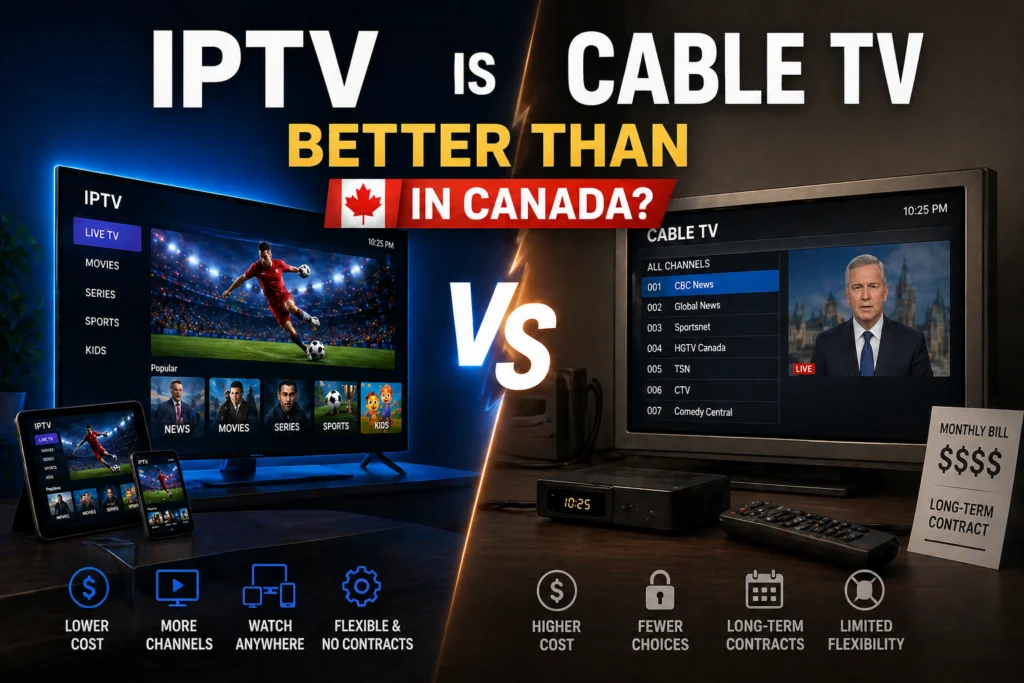
We are going to provide an honest, unbiased comparison between traditional cable and IPTV canada. Both systems have distinct advantages and noticeable drawbacks, and there is no universal right answer. The best choice ultimately depends on what you value most—whether that means absolute reliability, massive cost savings, or access to international content.
What Is Cable TV in Canada?
Traditional cable television relies on a physical infrastructure of coaxial or fiber-optic cables running directly into your home. A dedicated set-top box decodes the signal, bringing a specific lineup of live channels to your television screen.
The Canadian market is dominated by a few major telecommunications companies. Depending on your province, you likely receive service from Bell Fibe, Rogers, Shaw (now part of Rogers/Freedom), Videotron, or Cogeco. Because of limited competition, typical pricing in Canada ranges from $60 for bare-bones basic packages to well over $150 per month for premium channel bundles.
When you subscribe to cable, you get a highly regulated experience. The packages include specific local and national Canadian channels, a physical DVR to record shows, and official customer support you can call if your hardware breaks.
What Is IPTV?
IPTV stands for Internet Protocol Television. Instead of transmitting content via physical cables or satellite dishes, IPTV delivers live television and on-demand video over your internet connection.
There is an important distinction for Canadian readers to understand regarding legality. Some IPTV services are fully licensed by major broadcasters, while others operate as unlicensed third-party providers. You can access IPTV in several ways: through a subscription-based app on your smart TV, via a dedicated Android box, or directly on your mobile device. Typical pricing for a third-party IPTV service is drastically lower than cable, usually ranging from $10 to $30 per month.
Head-to-Head Comparison
To help you decide, let’s look at how these two services compare across several critical categories.
Price
Cable easily averages over $100 per month for a standard Canadian household wanting sports and entertainment. IPTV comes in at a fraction of that cost, often saving users hundreds of dollars a year.
Channel Selection
Cable guarantees all CRTC-regulated Canadian channels, regional news, and familiar networks. IPTV offers those same channels alongside thousands of international options, giving viewers a global catalog that traditional providers simply cannot match.
Picture Quality
Both services offer HD and 4K programming. However, cable provides a consistent broadcast quality, while IPTV picture quality heavily relies on the speed and stability of your home internet connection.
Reliability
Cable is generally highly reliable, working seamlessly unless there is a physical line cut or massive power outage. IPTV can occasionally experience buffering or server downtime, especially during massive live sporting events.
Contract and Flexibility
Cable companies love to lock customers into one-year or two-year contracts, sometimes hitting you with cancellation fees if you leave early. Most IPTV providers operate on a strict month-to-month basis, giving you total freedom to pause or cancel anytime.
Customer Support
If your cable box stops working, you can call Rogers or Bell and eventually get a technician to your house. Customer support for IPTV varies widely by provider; some offer excellent live chat, while others only use email ticket systems.
Device Compatibility
Cable is usually restricted to the television connected to the set-top box. IPTV works on almost any smart device, including iPhones, Android tablets, Amazon Firesticks, and smart TVs.
DVR and Catch-Up
Cable setups almost always include a physical PVR or DVR to record live television. Premium IPTV services replicate this by offering “Catch-Up” features, allowing you to watch previously aired shows on demand without having to manually record them.
Installation
Getting cable installed often requires scheduling a technician visit and waiting around during a four-hour window. IPTV is entirely self-installed and can usually be set up in a matter of minutes by downloading an app and entering your login details.
Where Cable TV Still Wins
Traditional television still holds a few distinct advantages. First, cable maintains reliability even during local internet outages. If your home Wi-Fi goes down, your cable box will usually continue broadcasting without interruption.
Cable also guarantees access to local Canadian channels regulated by the CRTC, ensuring you never miss regional news or emergency broadcasts. Furthermore, it is incredibly user-friendly for non-tech-savvy individuals who simply want to pick up a remote and flip through channels. Finally, bundling your television, internet, and home phone with a single provider can simplify your monthly billing and provide official accountability when things go wrong.
Where IPTV Clearly Wins
IPTV shines brightest when you look at your bank account. The massive cost savings make it incredibly appealing for Canadian households trying to cut expenses. Additionally, the lack of long-term contracts provides peace of mind.
If you want international content, IPTV is the clear winner. Traditional cable simply does not offer the sheer volume of global channels available through internet protocols. It also offers unparalleled flexibility, letting you watch your favorite shows on a tablet in the kitchen or a phone on the train. The Video on Demand (VOD) libraries are usually massive, acting like a built-in Netflix alternative. This makes IPTV perfect for expats and multicultural households living in Canada who want to stay connected to home.
Is IPTV Legal in Canada?

Many Canadians hesitate to switch because they are confused about the legality of internet television. It is important to distinguish between licensed IPTV services (like Bell Fibe TV app or Sportsnet Now) and unlicensed third-party streams.
Under Canadian law and the CRTC (including discussions around Bill C-11), it is not illegal for consumers to use internet protocols to watch television. The legal burden generally falls on the people hosting and distributing copyrighted content without a license, not the end-user streaming it in their living room. You can feel confident exploring the technology, though you should always ensure you are purchasing subscriptions from reputable providers.
Who Should Stick With Cable?
Cable remains the best choice for seniors or users who get easily frustrated by new technology. If you live in a rural Canadian area with unstable or heavily capped internet speeds, streaming live television will likely cause constant buffering. Stick with cable if you want zero setup hassle and absolutely need guaranteed local broadcasts to start your day.
Who Should Switch to IPTV?
You should strongly consider switching if you are currently paying $80 or more a month just to watch a few specific channels. Multicultural households wanting affordable access to international news and entertainment will find incredible value here.
It is also ideal for people who prefer watching content across multiple devices rather than sitting in front of a single television. Sports fans looking for out-of-market games that traditional cable blocks will find IPTV to be a game-changer. Lastly, anyone tired of negotiating annual contracts with major telecom companies will love the month-to-month freedom.
What You Need to Run IPTV in Canada
If you are ready to make the switch, you need a stable home internet connection. A minimum download speed of 25 Mbps is recommended for smooth HD streaming, though 50 Mbps is better for 4K content and busy households.
You also need a compatible device. Amazon Firesticks, Android TV boxes, and modern smart TVs are the most popular choices. When looking for a reliable Canadian IPTV provider, seek out services that offer dedicated support channels, a wide selection of VOD content, and a solid track record of server uptime. If you are looking for a great place to start, our premium IPTV service offers all of this alongside an extensive channel lineup.
Making the Right Choice for Your Entertainment
When you place them side-by-side, IPTV subscriptions wins heavily on price and flexibility, while traditional cable holds the crown for absolute reliability and simplicity. The overall trend in Canada is clear: more households are cutting the cord and making the switch to internet-based television every single year.
If you are tired of high bills but nervous about the technology, you do not have to jump in blindly. We encourage you to try a free or low-cost trial before you call your cable company to cancel. Experience the massive channel list and user-friendly interface for yourself. Start your trial with our reliable IPTV service today and discover exactly what you have been missing