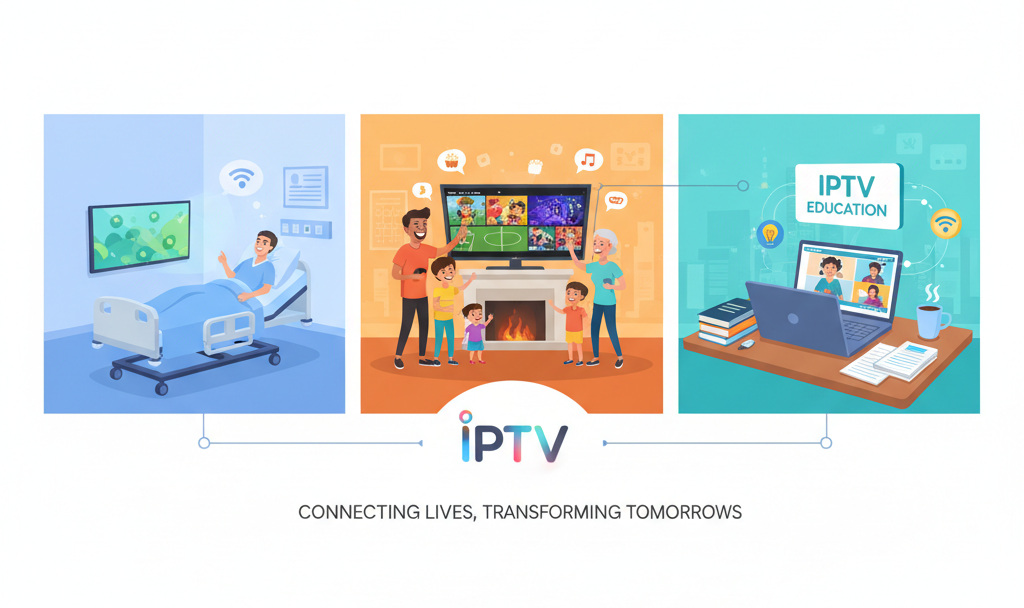
Hospitals and clinics have long relied on a patchwork of outdated cable systems, DVD players, and consumer streaming accounts to keep patients entertained. The result is often a frustrating experience, poor picture quality, limited content choices, and potential legal exposure from using services not licensed for commercial display. IPTV for healthcare offers a cleaner, more capable alternative.
IPTV, or Internet Protocol Television, delivers live TV programs and on-demand video content through IP networks rather than traditional broadcast, cable, or satellite signals. According to TechTarget, IPTV content is typically delivered over a managed or dedicated network, giving administrators far greater control over video quality, uptime, and bandwidth. That level of control makes it well-suited to demanding environments like hospitals, where network reliability is non-negotiable.
This post breaks down how IPTV works in healthcare settings, what benefits it offers, how to set it up, and where the technology is headed next.
The Core Benefits of IPTV for Healthcare Facilities
Simplified, All-in-One Content Access
One of the biggest frustrations in legacy hospital TV setups is fragmentation. Staff manage separate contracts for cable channels, on-demand content, patient education systems, and internal communications. IPTV consolidates all of this into a single infrastructure. Live news, sports, on-demand entertainment, wellness programming, and institutional messaging can all run from one platform.
Cost Efficiency Through Consolidation
Bundling these services under one IPTV Canada subscription typically reduces overall spend compared to maintaining multiple separate contracts. Beyond subscription costs, a managed IP network also lowers hardware maintenance burden, particularly as older analog infrastructure is retired.
Legal Compliance With Commercial Licensing
This point deserves emphasis. Consumer streaming services like Netflix, Hulu, and Disney+ explicitly prohibit commercial use in their terms and conditions. Showing these services in a waiting room, patient room, or staff break room, even with a standard subscription, can expose a facility to copyright liability. A properly licensed IPTV service for healthcare solves this by including commercial playback rights as part of the offering. Before selecting any provider, facilities should confirm that the service holds the necessary commercial display licenses.
Improved Patient Experience
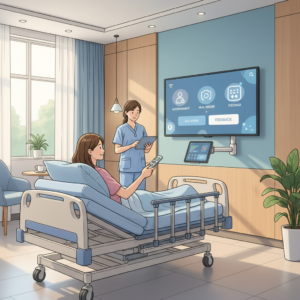
HFM Magazine notes that hospital TV systems have evolved well beyond passive entertainment. Modern interactive patient TV platforms now deliver targeted education videos, facility information, survey tools, meal ordering, and even EHR-integrated care updates, all from the bedside screen. IPTV serves as the underlying delivery mechanism that makes this kind of rich, personalized experience possible.
How IPTV Is Used Across Healthcare Environments
In Patient Rooms
The patient room is where IPTV has the deepest impact. Beyond standard TV channels, IPTV-enabled systems allow patients to access on-demand movies, educational programming, appointment reminders, and medication alerts. Platforms like LG’s Pro:Centric Smart IPTV, referenced by HFM Magazine, provide a familiar channel guide experience while also pushing customized notifications and health reminders directly to the screen.
Integration with electronic health records (EHRs) takes this further. Systems from vendors like eVideon and TVR Communications can automatically assign educational content based on a patient’s diagnosis or care plan, and document what the patient has viewed directly in their EHR record.
In Waiting Areas
Waiting areas benefit from IPTV’s content variety and ease of management. Instead of looping outdated DVDs or running a cable feed, facilities can curate a consistent, relevant mix of news, wellness content, and entertainment. Critically, this content must come from a provider with commercial licensing rights, not a consumer streaming platform.
For Healthcare Staff
Break rooms and staff lounges are also appropriate IPTV deployment zones. Access to live news and entertainment helps staff decompress during breaks. Some IPTV platforms also support internal communications channels, allowing facility leadership to push institutional updates, emergency notifications, or staff training content across all screens in the building.
IPTV for Patient Education and Entertainment
The distinction between entertainment and education in hospital TV systems has largely dissolved. As Scott King, CTO of eVideon, noted in HFM Magazine: “Since the dawn of interactive patient TV systems, they have provided entertainment such as movies and targeted patient education videos as well as displaying hospital information and offering survey tools.”
Today’s platforms go significantly further. Patients can receive condition-specific education videos triggered automatically by their admitting diagnosis. Comprehension checks, goal-setting tools, and even post-discharge follow-up content can be embedded in the same system.
For diverse patient populations, IPTV’s flexibility matters. Content can be delivered in multiple languages, and platforms can be configured to adjust educational materials based on patient demographics pulled from the EHR.
Setting Up IPTV in a Healthcare Facility
Choosing the Right Provider
Not all IPTV providers are built for institutional healthcare use. Key criteria to evaluate include:
- Commercial licensing: Does the provider hold rights to display content in a healthcare setting?
- Content depth: Does the platform offer the entertainment, news, sports, and educational content your patient population needs?
- EHR integration: Can the system connect to Epic or other EHR platforms used by your facility?
- Network requirements: What bandwidth and infrastructure does the service require?
- Vendor support: What level of onboarding and ongoing technical support is included?
Infrastructure and Hardware
IPTV deployments typically require smart TVs or set-top boxes at each endpoint, a reliable broadband or fiber network, and a head-end server or cloud-based distribution system. Many healthcare-focused IPTV vendors support delivery over existing coaxial cable infrastructure, which reduces installation costs in facilities that aren’t ready for a full network overhaul.
Network segmentation is worth considering early. Patient entertainment traffic should ideally run on a separate VLAN from clinical systems to prevent bandwidth competition and protect sensitive data.
Integration With Existing Systems
A well-implemented IPTV system doesn’t operate in isolation. As noted in HFM Magazine, modern patient engagement platforms interface with food management software, real-time locating systems, pharmacy systems, and EHRs. Getting this right requires coordination between your IT team, the IPTV vendor, and the clinical informatics team from the outset.
Enhancing Patient and Visitor Experience
A hospital stay is stressful by nature. Having meaningful control over one’s immediate environment, choosing what to watch, accessing entertainment on demand, ordering meals from a screen, gives patients a sense of agency that contributes to overall wellbeing.
Interactive features within IPTV platforms deepen this further. TVR Communications’ pCare system, for example, allows patients to provide real-time feedback on their room experience via the TV remote. Staff receive these responses and can address concerns quickly. That kind of rapid feedback loop would be difficult to achieve without an integrated IPTV platform.
Mobile integration is also expanding. Tablets and smartphones increasingly serve as second-screen companions to the bedside TV, allowing patients to search for content, input information more easily, or access the system from a chair or bed position where the TV isn’t ideal.
The Future of IPTV in Healthcare
The trajectory of healthcare IPTV points toward deeper personalization and broader integration. Near-term developments include tighter connections between entertainment systems and telemedicine platforms, enabling care teams to initiate video consultations directly through the patient’s room TV.
Longer-term, AI-driven content recommendations could tailor programming to individual patient preferences and health goals, suggesting mindfulness content to a patient recovering from cardiac surgery, for instance, or a specific nutrition education series to someone managing a new diabetes diagnosis. As healthcare continues its shift toward value-based care, IPTV platforms that actively support patient engagement and post-discharge adherence will become increasingly valuable.
Globally, adoption of IPTV in healthcare settings is expected to grow as IP-based infrastructure becomes standard and the clinical case for interactive patient engagement becomes harder to ignore.
IPTV Is Worth the Investment
The argument for deploying IPTV in healthcare facilities is straightforward: it consolidates fragmented legacy systems, eliminates consumer streaming licensing risks, improves the patient experience, and opens the door to sophisticated patient education and engagement tools that integrate with clinical workflows.
Facilities that still rely on analog cable systems or unauthorized consumer streaming accounts are leaving both value and compliance on the table. A properly selected and implemented healthcare IPTV solution changes that picture entirely.
If your organization is evaluating options, start with providers that specialize in healthcare environments and can demonstrate both commercial licensing compliance and EHR integration capability. The technology is mature enough to deliver real results, and the patient experience benefits make it worth exploring now.