IPTV scams in Canada usually follow a handful of patterns: a “lifetime” deal that disappears, a seller in your private messages, a cloned website, a “payment failed, send it again” message, or a free app that installs malware. The good news is that almost all of them are easy to spot once you know what to look for. This guide explains 12 common IPTV scams, how each one works, the warning signs, and exactly what to do and who to call in Canada if you’ve been caught.
Key takeaways
- The biggest red flags: lifetime deals, prices far below the market, no free trial, sellers who only use private messages, and pressure to pay now.
- Only use payment details from a provider’s official website or support channel. Clone sites and fake support numbers are common.
- Never install “free IPTV” apps from strangers. Malicious apps are a bigger risk than a lost subscription.
- If you’ve been scammed: call your bank first, then report it to the Canadian Anti-Fraud Centre at 1-888-495-8501.
- Beware of “recovery” services that promise to get your money back for a fee. That’s a second scam.
Scam or Just a Bad Service?
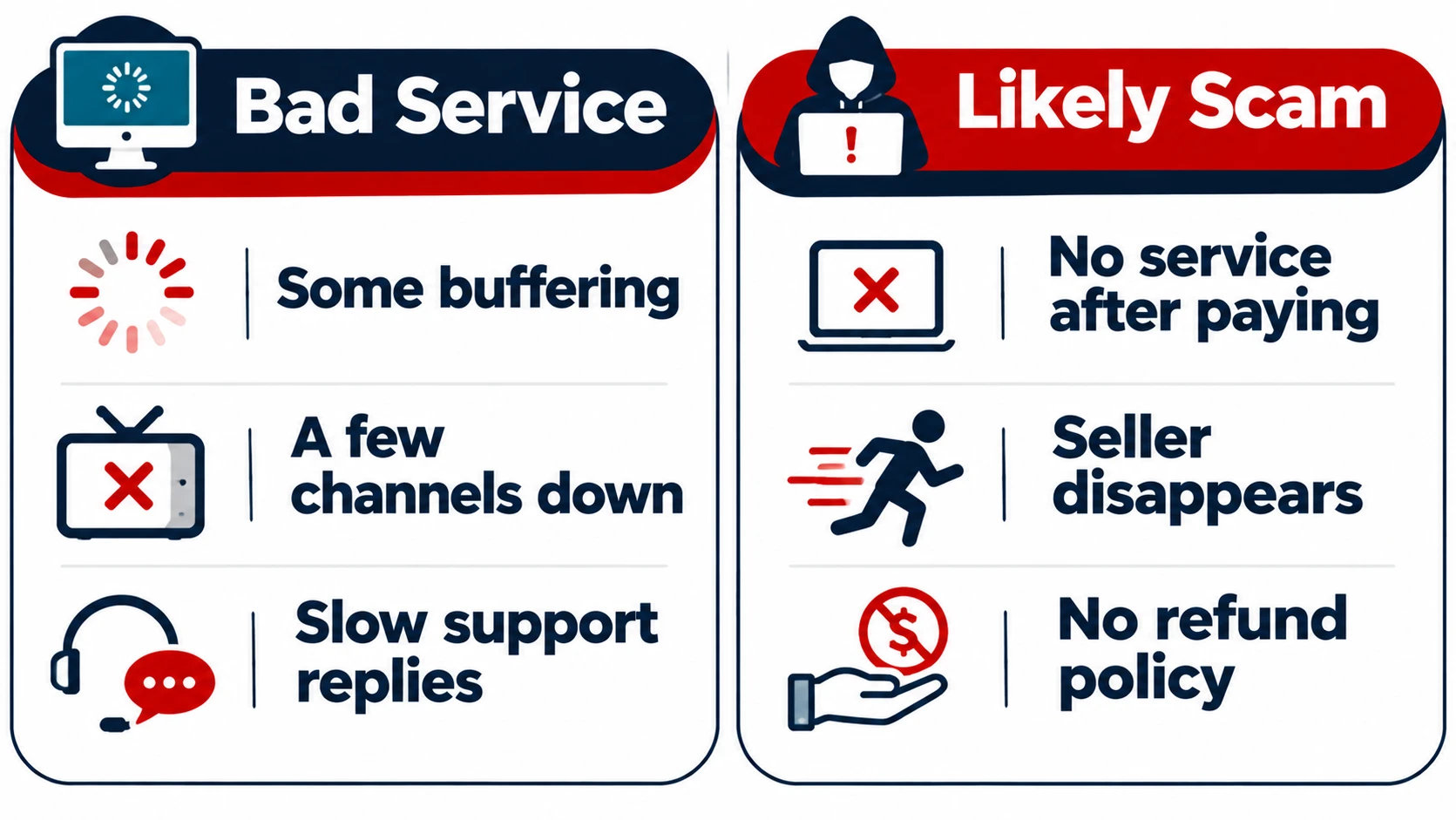
Not every disappointing IPTV service is a scam. Buffering can come from your Wi-Fi, an old device or a busy evening. Here’s how to tell the difference:
| Probably a bad service | Probably a scam |
|---|---|
| Some buffering at peak times | No service at all after payment |
| A few channels missing or down | The website or seller vanishes |
| Slow but real support replies | Support stops answering once you’ve paid |
| Refund process exists but is slow | No refund policy, or “all sales final” |
| Price is low but within the market | “Lifetime” or $10-a-year deals |
If you’re dealing with the first column, our guides to fixing IPTV that’s not working and IPTV freezing at night may solve it. If it’s the second column, read on.
12 Common IPTV Scams in Canada
1. The “lifetime subscription”
How it works: pay once, watch forever, often for $50–$150. The service works for a few weeks or months, then stops, and the seller is gone.
Why it fails: servers and bandwidth cost money every month. A one-time payment can’t fund an ongoing service.
Protect yourself: never buy “lifetime.” Never prepay for longer than you’ve seen a provider work reliably.
2. The impossible annual price
How it works: “25,000 channels for $15 a year.” The seller packs far too many customers onto too few servers, or simply collects payments until complaints pile up.
Protect yourself: know the market. Good IPTV in Canada usually costs $15–$20 for a month and $60–$90 for a year. See how much IPTV costs in Canada.
3. The DM seller
How it works: you ask about IPTV on Reddit, Facebook or a sports forum, and someone messages you privately with a “great deal” and a discount code. There’s no website, no business name and no refund policy.
Protect yourself: treat unsolicited private messages as ads, and never pay someone you can’t identify.
4. The clone website
How it works: scammers copy a real provider’s website, name or logo on a look-alike domain, then take payments for a service that doesn’t exist. Some also run fake “support” WhatsApp numbers.
Protect yourself: type the provider’s address yourself or use a bookmark. Check the domain spelling carefully, and only use contact details listed on the official site.
5. “Payment failed, please send it again”
How it works: after you pay, you’re told the payment didn’t go through and asked to resend, so you pay twice.
Protect yourself: always check your banking app first. If the first transfer shows as sent or deposited, don’t send another. Share the reference number with support instead.
6. The “free trial” that needs your card
How it works: a “free” trial requires card details, then quietly turns into a recurring charge that’s hard to cancel.
Protect yourself: a genuine IPTV trial shouldn’t need a card. If one does, read the renewal terms before entering anything. Learn more in the best IPTV free trials in Canada.
7. The “fully loaded” box
How it works: a box sold on marketplaces with “free TV forever” pre-installed. It works for a while, then the apps stop, and the seller has no support or refund.
Protect yourself: buy hardware and subscriptions separately. A real IPTV box comes with no channels. See our guide to the best IPTV box in Canada.
8. Malicious “free IPTV” apps
How it works: a free app or APK file from a forum, video description or random website promises every channel for free. Some of these apps carry malware or adware, or request permissions they don’t need.
Protect yourself: only install well-known player apps from official app stores or their developer’s own website. Never enter banking or email passwords into a streaming app. More in are there free IPTV services in Canada?
9. Fake reviews and paid “best of” lists
How it works: walls of five-star reviews posted the same week, or “Top 10 IPTV” lists where every recommended service belongs to the same seller.
Protect yourself: check reviews on third-party platforms such as Google, look at review dates and wording, and be sceptical of rankings that never mention downsides.
10. The disappearing reseller
How it works: a reseller sells access to someone else’s service. When the reseller stops paying the main provider, or vanishes, your service stops and no one is responsible for a refund.
Protect yourself: ask who provides support and refunds. Prefer buying directly from the provider that runs the service.
11. Phishing for bank codes or passwords
How it works: “support” asks for your online banking login, a one-time code sent by text, or your Google, Apple or Amazon password to “activate” your account.
Protect yourself: no legitimate IPTV provider ever needs these. Share them with no one.
12. The “recovery” scam
How it works: after you’ve lost money, someone contacts you claiming they can get it back, for an upfront fee. They can’t, and you lose more.
Protect yourself: real recovery goes through your bank, the police and official agencies, never through a stranger charging a fee.
The 60-Second Provider Check
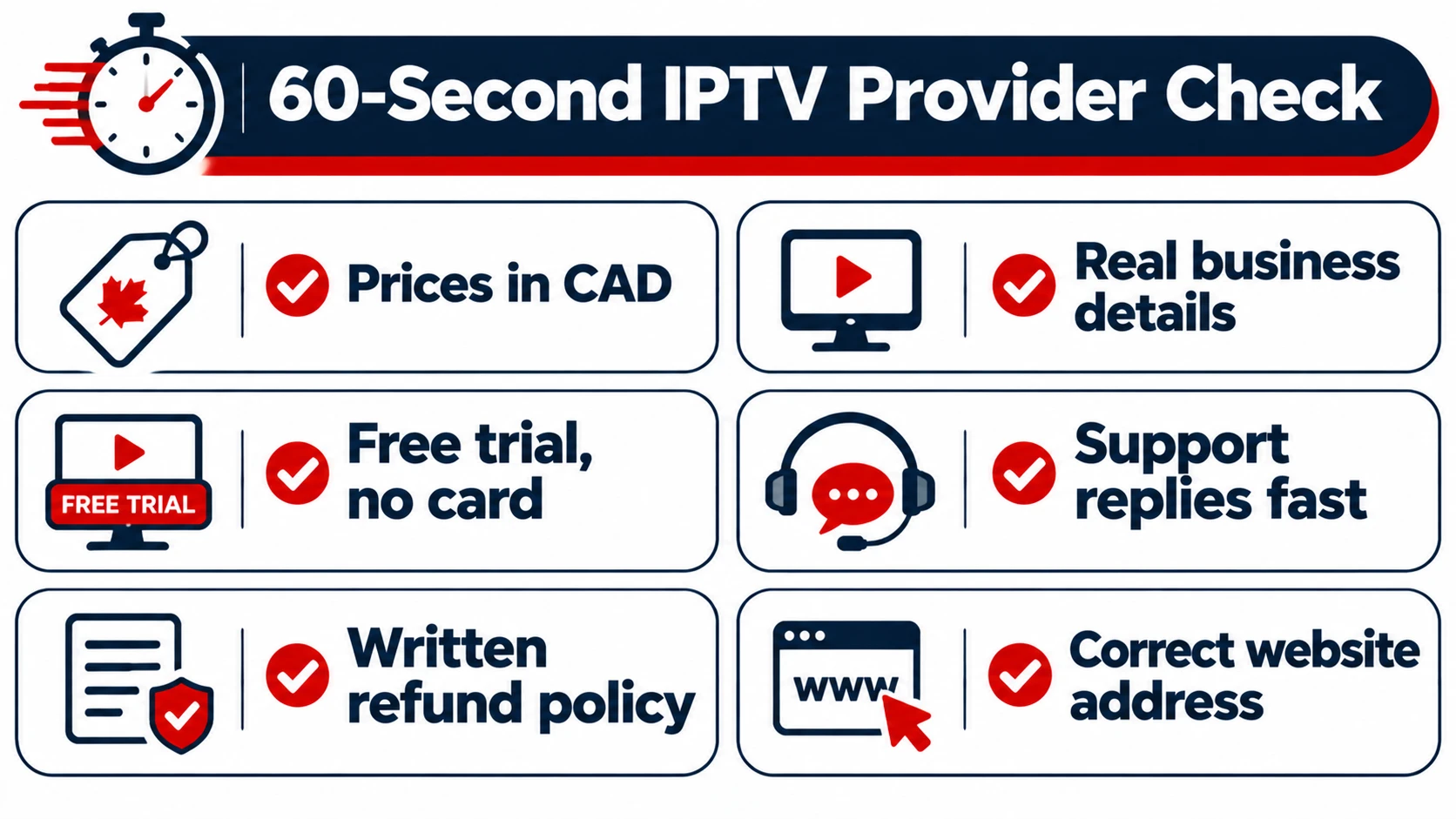
Before you pay any IPTV provider, check these six things:
- Published prices in CAD on a real website, with fixed plan lengths and no “lifetime.”
- A free trial with no credit card.
- A written refund policy with a specific number of days.
- Business details: an address, contact options and reviews on a third-party platform.
- Support that answers before you pay. Send a question and time the reply.
- The correct domain. Make sure you’re on the official site, not a look-alike.
A provider that fails two or more of these isn’t worth the risk. For the full buying process, see how to buy an IPTV subscription in Canada safely.
Payment Methods Scammers Prefer
Scammers favour payment methods that can’t be traced or reversed. Be most cautious with:
- Gift cards: never a legitimate way to pay for a subscription.
- Crypto to a personal wallet with no other option.
- Bank transfers to individuals whose name doesn’t match the business.
Interac e-Transfer is widely used by legitimate Canadian providers, but Interac warns that a transfer can’t be reversed once the recipient deposits it. Test first, check the recipient name if your bank shows it, and start with one month. Our step-by-step guide to paying for IPTV by Interac e-Transfer covers this in detail.
What to Do If You’ve Been Scammed
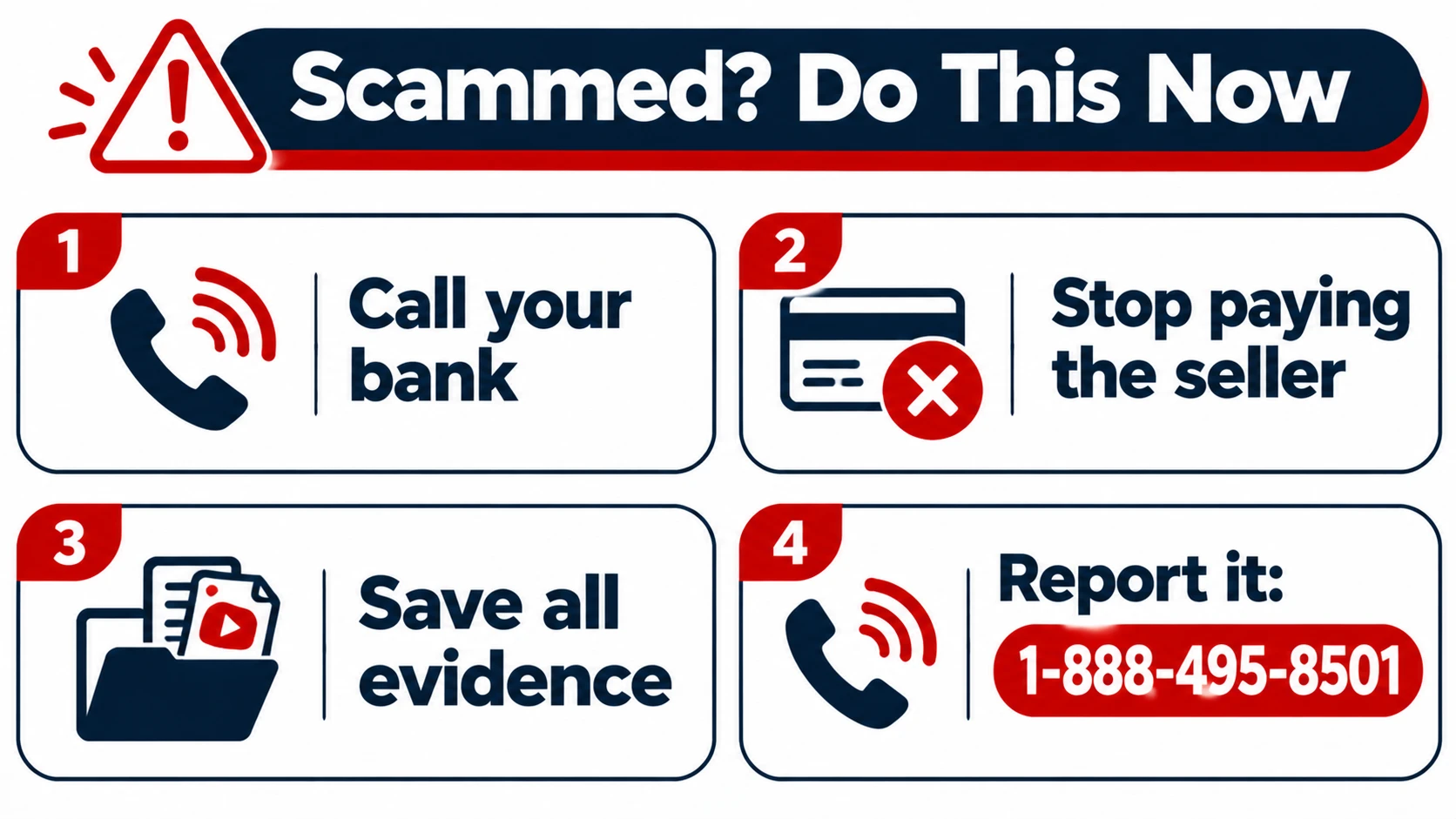
- Contact your bank or card issuer immediately. If you paid by credit card, ask about a chargeback. If you sent an e-Transfer that’s still pending, cancel it. If it was deposited, ask the fraud team whether anything can be done.
- Stop all contact with the seller and don’t send any more money, whatever they promise.
- Keep everything: screenshots of the website, messages, receipts, transfer reference numbers and the seller’s contact details.
- Report it to the Canadian Anti-Fraud Centre online through its fraud reporting system or by phone at 1-888-495-8501. You can report even if you didn’t lose money.
- Report misleading advertising to the Competition Bureau, and contact your local police if you lost money.
- Secure your accounts. If you shared any passwords or codes, change them and turn on two-factor authentication.
- Ignore “recovery” offers that arrive afterwards.
Reporting matters. The Competition Bureau notes that the Canadian Anti-Fraud Centre estimates fewer than 5% of fraud victims report their experience to law enforcement. Every report helps authorities spot patterns and warn others.
How to Protect Yourself Going Forward
- Buy from providers with a real website, published CAD prices and a written refund policy.
- Always take the free trial first, then start with one month.
- Bookmark the provider’s official site and use only the contact details listed there.
- Install only well-known player apps, and keep your devices updated.
- Keep receipts and confirmations for every payment.
- Be sceptical of urgency: countdown timers, “last 3 spots” and “price goes up tonight.”
Worried about privacy on shared networks? See is it safe to use IPTV on public Wi-Fi? For the legal side of IPTV, read can you use IPTV in Canada?
Warning Signs at Each Stage
| Stage | Warning signs |
|---|---|
| Finding a provider | Found through an unsolicited message, a look-alike domain, a paid “Top 10” list with no downsides, or reviews all posted the same week |
| Before paying | No trial, a trial that needs a card, no refund policy, prices “by DM only,” a countdown timer, or support that won’t answer questions |
| At checkout | Price changes at the last step, gift cards or crypto-only payment, a recipient name that doesn’t match the business, or requests for passwords or codes |
| After paying | “Payment failed, send again,” no login after several hours, support goes silent, or a sudden demand for an “activation fee” |
| After a loss | Strangers offering to recover your money for a fee |
One sign on its own isn’t proof of a scam, but two or more at the same stage is a strong reason to walk away. A trustworthy provider will happily answer questions, give you time to test, and put its terms in writing.
Questions to Ask a Provider Before You Pay
- What’s your business name, and where are you based?
- Is there a free trial, and does it require a card?
- What’s your refund policy, and does it apply after the trial?
- How many devices can watch at once on this plan?
- How will I receive my login, and how long does activation take?
- Who do I contact if the service stops working?
Clear, quick answers are a good sign. Vague replies, pressure to pay first, or no reply at all tell you everything you need to know.
How IPTVCAD Handles Trust
Disclosure: IPTVCAD is our own service. Run the 60-second check on us like anyone else:
- Published prices in CAD, from $19 for one month to $79 for 12 months, with no lifetime plans
- A free 24-hour trial with no credit card (request it here)
- A written 7-day money-back guarantee
- Based in Mississauga, ON, with a 5.0 rating from 153+ Google reviews
- 24/7 support on WhatsApp, and we’ll never ask for your banking password or codes
See IPTVCAD’s plans once you’ve tested us.
Bottom Line
Most IPTV scams in Canada rely on the same tricks: unrealistic prices, lifetime deals, private-message sellers, cloned websites and pressure to pay fast. Take the free trial, pay only through official channels, start with one month and keep your records. If something goes wrong, call your bank first and report it to the Canadian Anti-Fraud Centre.
Frequently Asked Questions
How can I tell if an IPTV service is a scam?
Watch for lifetime deals, prices far below the market, no free trial, no refund policy, sellers who only use private messages, and pressure to pay immediately. A legitimate provider has a real website, published prices and support that answers before you pay.
Are lifetime IPTV subscriptions a scam?
They’re the most common IPTV scam. Servers cost money every month, so a one-time payment rarely keeps a service running. Many lifetime services stop working within months.
What should I do if I paid for IPTV and got nothing?
Contact your bank or card issuer immediately, keep all receipts and messages, stop paying the seller, and report it to the Canadian Anti-Fraud Centre online or at 1-888-495-8501.
Can I get my money back from an IPTV scam?
It depends on how you paid. Credit card payments can often be disputed. Interac e-Transfers can be cancelled while pending but generally not once deposited. Contact your bank right away, and ignore anyone offering paid “recovery” services.
Are free IPTV apps safe?
Many aren’t. Unknown free IPTV apps and APK files can contain malware or adware. Install only well-known player apps from official stores, and never enter passwords or banking details into them.
Is it safe to buy IPTV from someone on Reddit or Facebook?
It’s risky. Unsolicited private-message sellers usually have no website, refund policy or accountability. Buy from providers with a real website and published terms.
Where do I report an IPTV scam in Canada?
Report it to the Canadian Anti-Fraud Centre online or at 1-888-495-8501, contact your bank, and report misleading advertising to the Competition Bureau. Contact local police if you lost money.